
Move-in concierge vs unpacking and organizing: the difference at a glance
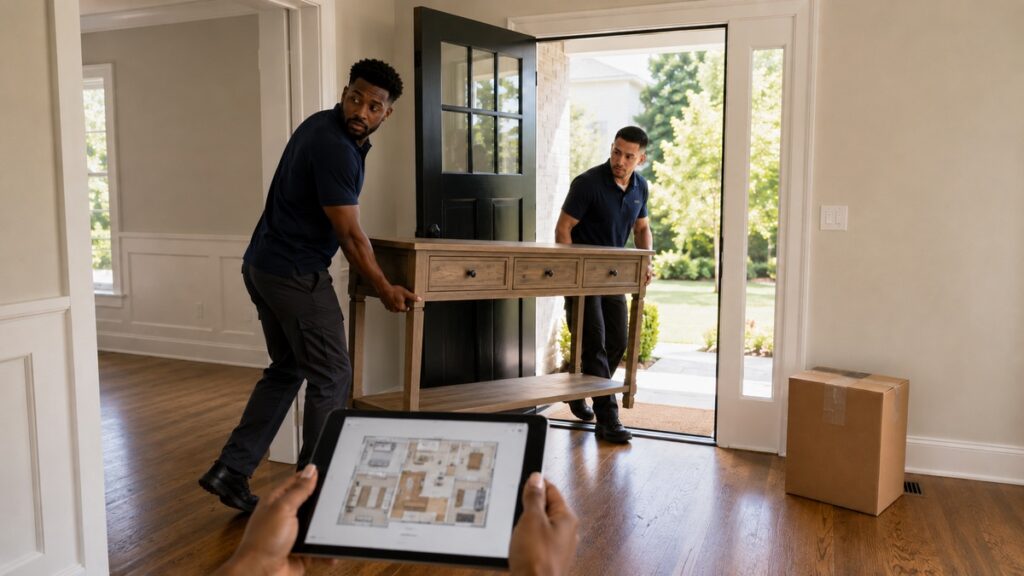
If you are comparing move-in concierge vs unpacking and organizing, the primary difference is the scope of responsibility.
Moving into a new home involves more than emptying boxes. Belongings need a logical place, household systems need to function, and vendors, deliveries, and decisions may still be in motion.
This is where the distinction between Unpacking & Organizing and Move-In Concierge matters.
Unpacking & Organizing makes the client’s belongings and household systems functional from day one. Move-In Concierge encompasses that work, then adds the coordination of whole-home details beyond the boxes so the entire home is ready for daily life.
Either service can be completed while the client is home, working, or traveling. The defining difference is the scope of responsibility, not the client’s location or the size of the team.
The difference at a glance
| Unpacking & Organizing | Move-In Concierge | |
|---|---|---|
| Foundation | Unpacks and thoughtfully organizes the client’s belongings | Encompasses the full Unpacking & Organizing process |
| Household systems | Creates functional rooms, cabinets, drawers, and storage areas around how the client lives | Includes those same functional household systems |
| Additional coordination | Focuses primarily on the belongings and organizing systems | Adds whole-home readiness, which may include scheduling or overseeing vendors, installations, utilities, deliveries, cleaning, and household stocking |
| Day-one result | The client can use agreed priority spaces and find essential items while the remaining unpacking continues. | The client receives that organized foundation plus the agreed household details needed for the entire home to function from day one |
The exact scope varies by provider and project, which is why clients should ask what is included before assuming that either label represents a standard package.
Day-one functionality does not necessarily mean every box has been unpacked. It means you can sleep in your bedroom, use your bathroom, access the vital parts of your kitchen, make coffee, and, if you partake, pour a glass of wine or make a cocktail at the end of the day. The home supports your essential routines while the remaining work continues.
What does Unpacking & Organizing include?
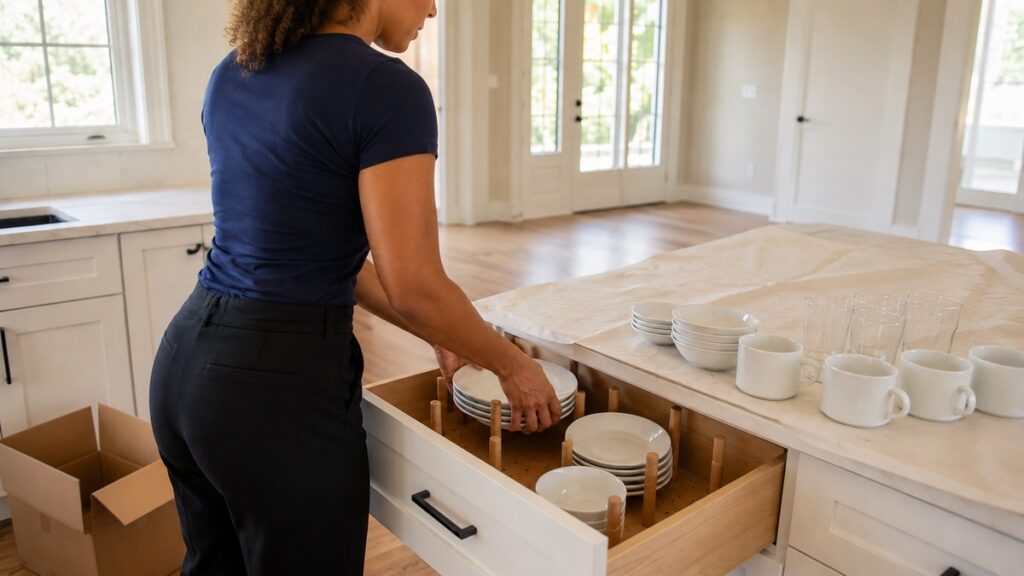
Professional unpacking is not simply taking items out of boxes and placing them on the nearest available shelf. Its purpose is to create functional systems around the people who will actually live in the home.
If you are deciding whether the moving crew should handle this part, Should You Let Movers Unpack for You? explains why moving and organizing require different skills.
An experienced professional may consider:
- Which rooms need to become functional first
- How the client enters and moves through the home
- How frequently different items are used
- How the client cooks and entertains
- Where shoes, bags, keys, and mail naturally land
- Whether organizing products or labels are useful
For example, a kitchen belonging to someone who cooks every day should not be arranged like one belonging to someone who primarily orders in. Using every available inch can also make a new system harder to maintain.
Thoughtful decisions made before delivery can prevent avoidable problems later. I cover several of them in 10 Packing & Unpacking Mistakes That Make Moving Harder.
In my own work, I group like items before assigning their final locations, map storage areas before filling them, and adjust the plan when the actual volume differs from what was expected. Empty boxes are broken down and staged in an agreed low-traffic area so the home can continue taking shape without packaging debris taking over.
Clients may be closely involved, available only for occasional questions, or comfortable authorizing most placement decisions in advance. The work generally moves fastest when the professional has room to execute while the client or their representative remains reachable when needed.
What does Move-In Concierge include?
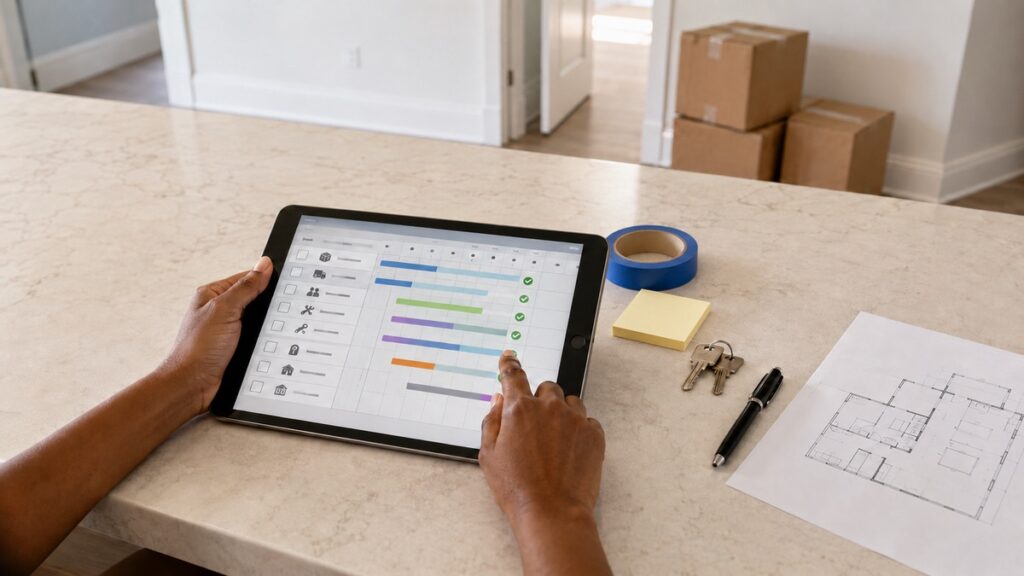
Move-In Concierge begins with everything included in Unpacking & Organizing, then extends beyond the contents of the boxes. Its purpose is to coordinate the remaining details required to make the entire home ready for the client’s arrival and daily routines.
Depending on the project, the additional concierge layer may include:
- Coordinating movers, installers, handymen, cleaners, and other professionals
- Receiving furniture, appliances, and product deliveries
- Overseeing WiFi, television, utility, or household equipment setup
- Arranging final cleaning after vendors complete their work
- Stocking groceries, beverages, household staples, and requested backstock
- Monitoring estimates, approvals, invoices, and project documentation
- Collecting mail and packages while the client is away
An unpacked house may still require installation appointments, groceries, working WiFi, cleaning, and vendor follow-up. Move-In Concierge addresses that wider layer of readiness.
The refrigerator can be stocked, the wine chilled, the televisions mounted, and the essential household systems working. The client is not returning to a second job. They are returning home.
Can either service be completed while the client is away?
Yes. The client’s absence does not automatically make a project Move-In Concierge.
If a professional unpacks and organizes the client’s belongings while the client travels, the service can still be Unpacking & Organizing. If that responsibility expands to installations, utilities, vendors, cleaning, deliveries, stocking, and overall arrival readiness, it becomes Move-In Concierge.
This is an important question to ask when comparing services: Who is responsible for the details beyond the belongings?
What should be established before the work begins?
Successful delegated move support depends on clear authority, access, and communication. Before work begins, the client and professional should agree on:
- Project priorities and what completion means
- Which decisions the professional may make independently
- Spending limits and purchasing authorization
- Who can approve estimates or changes
- Preferred communication methods and response times
- How often progress updates will be provided
- Who may enter the property and whether vendors may remain without supervision
For shorter projects, a client may want arrival and departure texts plus an end-of-day summary. Longer projects may work better with beginning, middle, and end-of-week updates. The right cadence provides visibility without requiring the client to supervise the work.
I describe this as delegated, not disconnected. If a client already has a house manager, assistant, or household team, I work in partnership with them. They know the client’s routines and standards. I bring move-specific organization, sequencing, and on-site execution. The goal is to help the team create a home that is already running well.
Why do access and security need their own plan?
When a client will not be onsite, property access should be resolved before the first workday. Depending on the home, the professional may need:
- Front-desk, concierge, or building-management authorization
- Gate, door, lock box, or temporary smart-lock codes
- Alarm instructions
- Parking and elevator permissions
- Keys or another approved entry method
- WiFi access for installations, video calls, and reliable communication
Access control should also cover the end of the workday. If another approved professional remains in the home, the client should know who is there. If vendors may not remain unsupervised, everyone should leave before the property is secured.
In my work, I double-check and triple-check all doors, windows, locks, and any access point that may have been opened. Personal mail remains unopened in a designated location. If something appears important or time-sensitive, I can photograph the exterior and alert the client. Packages intended for the project can be opened so the contents can be confirmed and the work can continue.
When my client cannot be present, I serve as their eyes inside the home. I pay attention to the property, the belongings, the work being completed, who has access, and how the home is left each day.
What about pets during move-in?

Pets need a move-in plan too. Exterior doors may remain open while movers carry items inside, vendors come and go, and packaging debris is removed. The noise and foot traffic can also create tremendous anxiety for an animal who does not understand the disruption.
Ideally, a pet has a trusted auntie, uncle, or daycare for the busiest move days. Otherwise, a quiet, secure, low-traffic room should be reserved for them.
The ASPCA’s Moving With Your Pet guide offers additional guidance for keeping animals safe and reducing their stress throughout the transition.
This helps prevent a frightened or curious pet from slipping outside, becoming lost in the shuffle, or being accidentally stepped on. Their safety and comfort belong in the move plan because they live in the home too.
Taking care of a home means considering the entire household. Once the doors are closed and the activity settles, the fur babies generally become my shadow anyway.
How should vendors, approvals, and purchases be handled?
A move-in professional may recommend and coordinate outside providers, but the client, the move-in professional, and any house manager, assistant, or household staff involved should agree on who is responsible for what. This keeps the work collaborative, prevents duplicated efforts, and ensures the client knows who is entering the home.
The written contract should reflect the details of that particular project, including the scope, responsibilities, access, approvals, purchasing, and payment arrangements that apply. Every vendor may not be known when the agreement is signed, but the process for approving third-party services should be clear. If a move-in professional is coordinating this level of work without a project-specific contract, that is a red flag. A project involving someone’s home, money, belongings, and privacy should not operate on assumptions, vibes, or great energy.
In my work, I can suggest vendors, request estimates, coordinate scheduling and access, receive invoices, and sign for completed work when authorized. The client or their designated representative provides final approval and payment, and the relevant documentation is shared with the appropriate people.
Delegation should make the process easier. It should never leave the client or their household team out of the loop.
What does experience add to move-in support?
Checklists are useful, but experience changes what gets noticed. After more than 11 years and over 150 moves, I know that the standard plan is not always the right plan.
Experienced oversight means recognizing when a fragile or meaningful possession requires a different transportation plan, when storage does not suit the client’s routines, and how to sequence vendors so completed work is not immediately undone. It also means catching details that can stop an entire workday, such as missing access authorization.
Every belonging deserves care because it matters to its owner. When something requires a different level of protection, timing, or attention, the plan should adjust accordingly when feasible..
Which service is right for your move?
Choose Unpacking & Organizing when the primary goal is to have your belongings unpacked and thoughtfully arranged into functional household systems. It can be especially useful during a corporate relocation, a demanding work season, or any move in which you do not want to spend weeks living among boxes.
For a closer look at what this kind of support involves, read Can Someone Help Me Unpack After Moving?.
Choose Move-In Concierge when you want someone responsible for the broader readiness of the home, including the details beyond your belongings. It may be the better fit when you are traveling, working elsewhere, relocating between properties, setting up a second home, or simply do not have time to coordinate the remaining work yourself.
Before hiring anyone, ask for a clear scope of work. Service names can sound similar, but the actual responsibilities may be very different.
Move-in support in Henry County, South Metro Atlanta, and beyond
OCbyD provides Unpacking & Organizing, Move-In Concierge, and customized move support in Henry County and throughout South Metro Atlanta, including Stockbridge, McDonough, Locust Grove, Hampton, and Eagles Landing. Travel support is also available for select projects.
The initial consultation and walkthrough help determine what has already been handled, what remains, which professionals are involved, and how much responsibility the client wants to delegate.
If the approach described here sounds like the way you want your home, belongings, privacy, and fur babies cared for, schedule a consultation with OCbyD.
Your belongings deserve thoughtful systems. Your household deserves attentive oversight. And when you are overwhelmed, short on time, or simply do not want to manage it all yourself, I can take care of your space for you.